
Most brand activations end the same way. Guests collect a flyer or a branded pen, glance at it, and drop it in a bag. A few weeks later, the event is a blur of photos nobody opens again. The team spent real money on the stall, the staff and the stage, and the guest walked away with almost nothing that stayed with them.
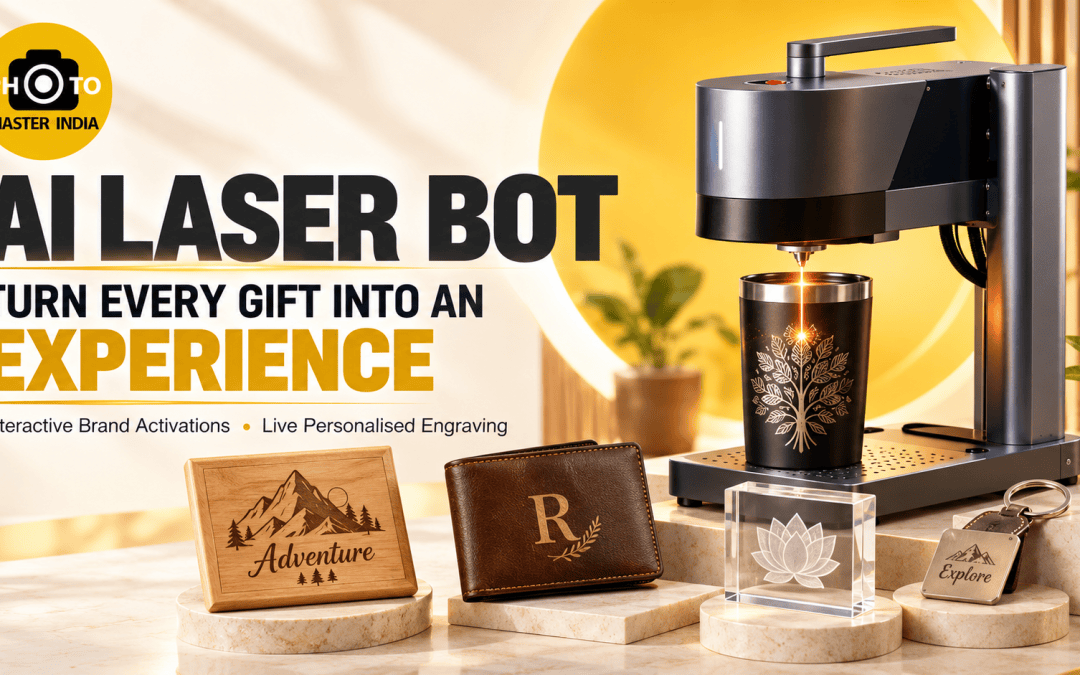
That gap is what interactive brand activations are supposed to close. More brands in India now want guests to do something, watch something happen, and leave with an object made for them. One format doing this well is the AI Laser Bot, a live laser engraving station that engraves a guest’s name, message or logo while they stand and watch.
This post explains where the format fits, what to look for in an AI Laser Bot vendor, and the mistakes we see brands make when they book one. It is written from the operator’s side, so the practical details matter as much as the concept.
Why Brand Activations Need a Reason to Stop People
Brand activations compete with a lot. Guests are checking phones, looking for food, or heading somewhere else. A banner can be ignored. A demo can be skipped. What works is something that takes a few seconds to understand and holds attention for a few minutes.
Good activations usually share three traits:
- They are easy to join. The guest does not need an app, a login or a long explanation.
- They involve the guest personally. The person’s name, face or choice is part of the result.
- They end with something the guest keeps. A photo on a phone is quickly lost. A physical item on a desk lasts.
Interactive formats like live portrait drawing, robotic video capture and live engraving all aim for those traits. The AI Laser Bot is one of the few that combines a visible process, a personal output and a durable keepsake in one station.
What a Live Laser Engraving Station Does
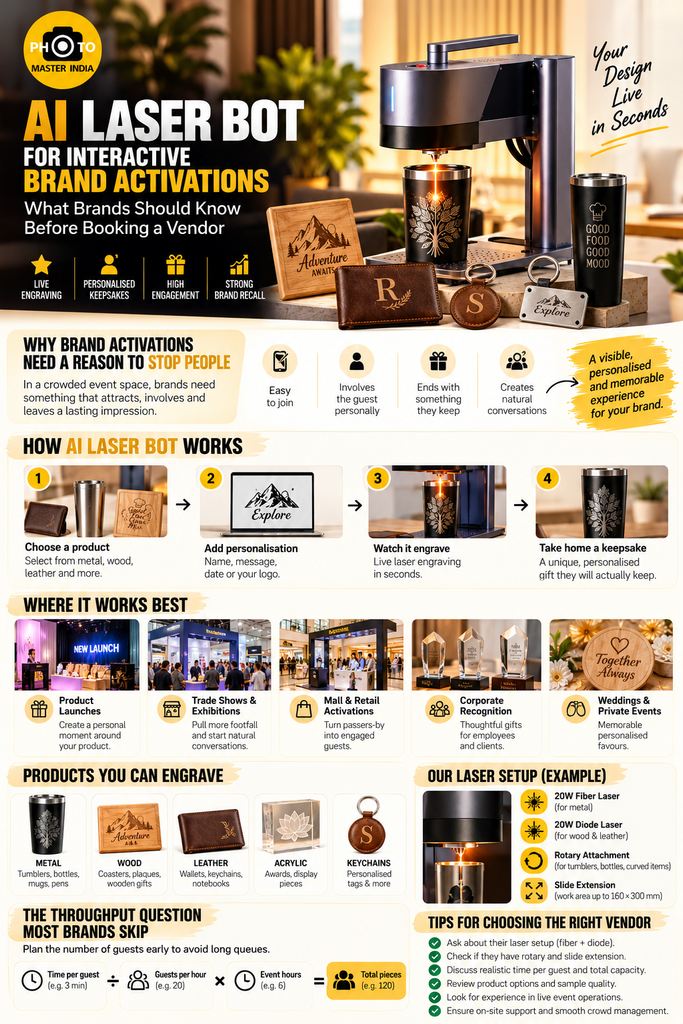
At its core, the AI Laser Bot is a laser engraving station built for live use. The guest chooses a product, adds a name, date, short message or logo, and the laser engraves it while they watch.
The format is different from a workshop. In a workshop, engraving is a production step that happens out of sight. On a brand floor, the engraving becomes the show. Passers-by stop to see a laser trace a name onto a steel tumbler. That pause is the opportunity the brand team needs.
A capable setup usually has three parts that affect what you can offer:
- Laser type. Fiber lasers suit metal. Diode lasers suit wood and leather. A station with both covers far more products.
- Rotary attachment. Tumblers, bottles, mugs, glasses and bracelets are curved. Without a rotary, the station is limited to flat items.
- Working area. A slide extension allows larger logos and longer text. The Photo Master India setup, for example, runs a 20W fiber laser and a 20W diode laser, with a rotary and a slide extension for work areas up to 160 × 300 mm.
These details decide whether a vendor can deliver the activation you have in mind. Ask about them before you ask about price.
Where Interactive Brand Activations Work Best
The format fits some brand goals better than others.
Product launches. A guest-chosen engraving beside the product logo ties the launch to a personal moment. It works especially well when the product is itself a premium item.
Trade shows and exhibitions. A live station pulls footfall from neighbouring stalls. People stop to watch, and the stall team gets a natural opening for a conversation.
Mall and retail activations. Shoppers pass by quickly. A visible process holds them for the few minutes it takes to choose a design and watch it engrave.
Corporate recognition moments. Engraved desk items for award winners or long-service staff feel more considered than printed certificates.
Weddings and private events. Brands rarely run these, but some partner with event companies. Engraved favours replace return gifts that guests tend to leave behind.
Where it is a poor fit: very large crowds moving through a space in a short window. One station cannot serve 1,500 people in twenty minutes, and a queue that never moves frustrates the guest and the brand.
The Throughput Question Most Brands Skip
The most common complaint about live engraving is not quality. It is the queue. Brand teams often plan the activation around the number of people they hope to reach, and forget to check how many engravings one station can produce.
The estimate is simple:
- Ask the vendor for the realistic time per guest for your product and design. For planning, a few minutes per simple personalisation is a reasonable starting point. A logo plus a name on a curved item takes longer.
- Divide 60 by that number to get guests per hour.
- Multiply by the hours the station is open to guests, not the event’s total length.
If one station handles about 20 guests an hour across a six-hour window, that is roughly 120 pieces. If you expect 400 guests, you need a plan. Options include a second station, pre-engraving the logo so only the name is done live, or limiting live engraving to a defined group such as VIPs, contest winners or registered attendees.
Doing this sum early tells you which activation design fits your audience. It also gives you a number to show the vendor so you can compare proposals on the same basis.
Choosing an AI Laser Bot Vendor: The Questions That Matter
Because the format is still new in India, quality and experience vary between operators. A workshop engraver and a live event operator are different skills. When you compare an AI Laser Bot vendor, ask:
- What laser setup do you run? You want coverage for metal and wood-type materials if your product range includes both.
- Can you engrave curved products? Ask about tumblers, bottles and bracelets specifically.
- What is the realistic output per hour for our design? A specific figure is a good sign. “As many as you need” is not.
- Will you test-engrave on our exact product? Finishes react differently. A good vendor will insist on a test.
- Who runs the station on the day? A trained operator should manage the line, the design check and the handover.
- What does the venue need to provide? Power, space, placement and setup time should be stated in writing.
- What is the backup plan? Ask what happens if there is a power problem or a technical fault mid-event.
- Have you run live events, or only workshop jobs? The answer tells you how the vendor handles queues and crowds.
Photo Master India was the first vendor to bring the AI Laser Bot to events in India, and it covers cities including Mumbai, Delhi NCR, Kolkata, Bangalore, Hyderabad, Chennai, Gujarat, Udaipur and Goa. Whichever vendor you choose, these questions should be answered before you sign.
For brands looking to rent AI Laser equipment for a single event or a multi-city tour, the same checklist applies. Ask for the output estimate, the product test and the operator details in writing.
Designing the Activation Around the Engraving
The machine is only one part of the experience. The design of the surrounding activation decides whether the station draws a crowd or sits quietly in a corner.
Pre-engrave the fixed element. If the logo appears on every item, engrave it in advance. Only the guest’s name is done live. This shortens each engraving and keeps the brand mark consistent.
Give the station a host. Someone should explain what is happening, manage the queue and hand over the finished piece. Without a host, guests do not know whether they are allowed to join.
Make the process visible. Place the station where people can see the laser working. Half the appeal is watching. A station behind a pillar loses most of its value.
Set a clear name-entry step. A card or tablet form before the counter reduces spelling mistakes and speeds the line. Always read the text back to the guest before engraving. A misspelled name on a permanent piece cannot be undone.
Plan for regional scripts. If guests may want names in Hindi, Bengali, Tamil or another script, confirm fonts and test them before the event.
Common Mistakes and Misconceptions
It is just a giveaway machine. It is closer to a live demonstration with a queue. Treat it as an activation, with staff, signage and flow, and it performs like one.
Every guest will get one. Only if the throughput maths supports it. Otherwise set expectations with clear signage or a token system.
Any engraving vendor can handle this. Workshop skill does not automatically translate to live events. Ask about the operator’s live experience and their setup for curved products.
A detailed design looks more premium. Usually the reverse. Bold, simple designs engrave faster and read better at a distance. Gradients, shadows and thin decorative lines do not translate well to engraving.
We can decide the product on the day. Products need sourcing, testing and stocking in the right quantity. Last-minute changes often mean compromises on quality or speed.
A low-resolution logo is fine. Send a vector file (SVG, AI, EPS or a clean vector PDF). A small JPG pulled from a website header usually engraves poorly.
Expert Tips From the Engraving Floor
Keep spare blanks. Occasionally a product has a manufacturing flaw. A few spares keep the line moving without a delay.
Close the queue before you close the station. Stop accepting new guests 20 to 30 minutes before the end, so nobody who waited walks away empty-handed.
Test the first ten pieces closely. The early engravings show whether the power settings, the product finish and the design size are right. Adjust then, not two hours later.
Let guests watch the next person. A display of finished pieces, or a simple sign showing what the next guest is choosing, keeps people interested in the queue.
Make the moment shareable. A small branded backdrop or a display of finished pieces encourages guests to photograph their keepsake. That turns the station into content for the brand’s own channels.
Use the engraving as a conversation starter. Staff at a stall can use the wait time to talk with guests about the product. The engraving gives people something to talk about that is not a sales pitch.
Where the AI Laser Bot Fits in a Wider Activation Plan
Some brands run the laser station alone. Others pair it with other formats to cover different guest preferences. An AI Laser Bot can sit alongside a robotic video booth for a fast, cinematic clip, or a live sketch station for a hand-drawn portrait. Guests who prefer video can choose one station, and guests who prefer a physical keepsake can choose another.
For a high-footfall event, pairing the laser station with a faster format keeps queues shorter. For a small, high-value audience, the laser station on its own often delivers the strongest result. The right mix depends on guest count, time window and brand goals.
Conclusion: Plan the Experience, Then Pick the Vendor
Interactive brand activations work when they give guests a reason to stop, a part to play and something to keep. The AI Laser Bot does all three, but only when the plan around it is realistic: honest throughput numbers, tested products, clean design files, a good position on the floor and an experienced operator.
If you are considering an AI Laser Bot vendor for an upcoming launch, exhibition or corporate event, start with the questions in this guide. Ask for the output estimate, the test engraving and the operator’s live experience before comparing prices. A vendor who answers those questions clearly is usually the one who will make the activation work on the day.
Photo Master India is happy to talk through your guest count, timeline and product options to help you decide whether a live engraving station fits your next activation.
Frequently Asked Questions
How do I know how many guests an AI Laser Bot can serve during a brand activation?
Start with the time per guest for your exact product and design, from text entry to handover. Divide 60 by that figure to get guests per hour, then multiply by the hours the station is open to guests. For example, a station handling about 20 guests an hour over six hours produces roughly 120 pieces. If your expected footfall is higher, you can pre-engrave the logo to speed each piece, add a second station, or restrict live engraving to a defined group. Ask your vendor for their own per-hour estimate for your design, and compare it with your guest count before you commit to a quantity.
What should I check in an AI Laser Bot vendor’s setup before booking?
Confirm the laser configuration, especially whether it covers both metal and wood-type materials. Ask whether the rotary attachment is included, since curved items such as tumblers and bottles need it. Check the working area size if your design includes a large logo or long text. Then ask who runs the station on the day, whether they will test-engrave on your exact product, and what the backup plan is for power or technical faults. A vendor who answers these clearly and in writing is more likely to deliver a smooth activation.
Can the AI Laser Bot work for a brand’s logo as well as guest names?
Yes, and this combination is usually the most effective. The logo is set in a fixed design before the event, and only the guest’s name or short message is personalised on the day. The brand mark stays consistent on every piece, and the guest still gets something made for them. Send the logo as a vector file, keep the design simple, and approve the layout with the vendor a few days before the event. This also shortens each engraving, which helps the queue.
Where should an AI Laser Bot be placed on a trade show floor or in a mall?
Place it where people pass naturally but will not block an entrance or walkway. A spot near the main aisle, close to the brand’s stall, works well because guests can see the laser working from a distance. Avoid dark corners and areas behind pillars, since the visible process is the main draw. Make sure there is a dedicated power point nearby, enough space for a clear queue, and some ventilation, because engraving can produce smoke or odour depending on the material.
How should a brand measure whether a live laser activation worked?
Measure more than the number of pieces engraved. Track how long guests stayed at the station, how many people stopped to watch rather than only those who joined the queue, and how many guests photographed or shared their keepsake. Ask stall or booth staff to note the conversations they had during the wait. Some brands also track follow-up actions, such as contest entries or enquiries, from guests who collected an engraved item. These signals show whether the activation drew real attention, which is what most brands are trying to buy when they book an interactive format.