
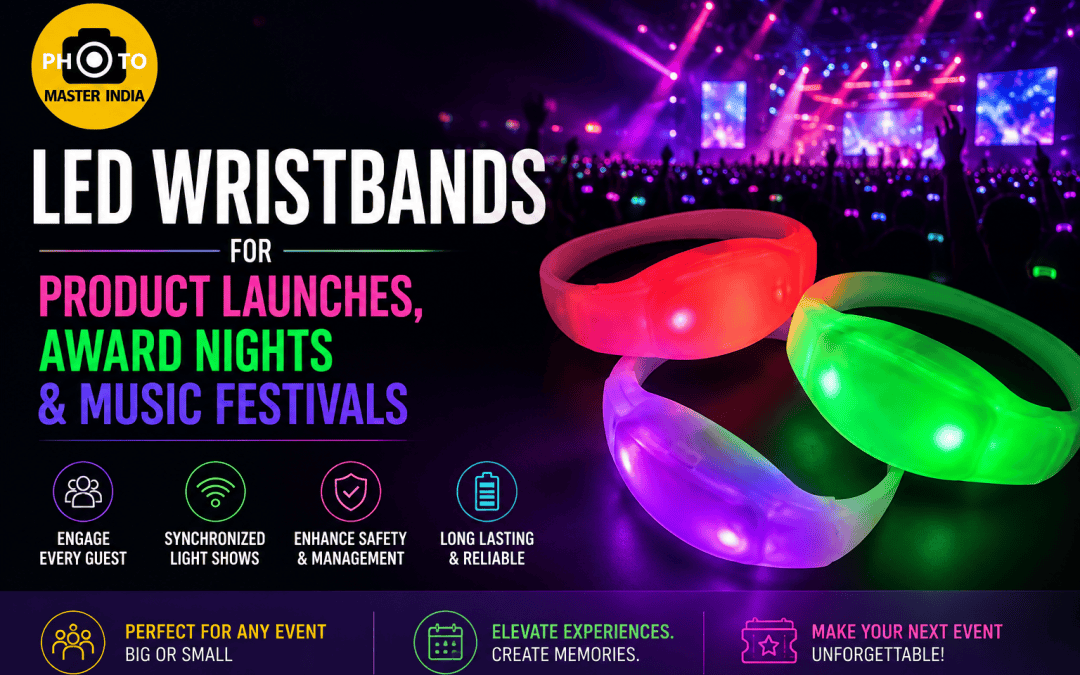
When I first worked with LED wristbands at a large-scale music festival three years ago, I witnessed something remarkable: 8,000 attendees weren’t just watching the stage—they were part of the production. Their wrists illuminated in perfect synchronization with the beat, creating an immersive visual experience that transformed an ordinary concert into something unforgettable.
This is the power of LED wristband rental for event night experiences, and it’s not just about flashiness. From product launches where you need to guide attendee flow, to award nights where you want to celebrate winners, to music festivals demanding high-energy atmosphere—LED wristbands solve real event production challenges while creating memorable experiences your guests will talk about for months.
If you’re an event organizer, venue manager, or brand activations lead asking yourself “Should we invest in LED wristbands for our next event?”—you’re asking the right question. This guide draws from real event production experience to show you exactly how LED wristbands work, when they’re the right choice, and how to avoid costly mistakes that many first-time users make.
Understanding LED Wristbands: More Than Just Glowing Accessories
What Exactly Are LED Wristbands and How Do They Work?
LED wristbands are wireless, battery-powered wearable devices that emit colored light and synchronized patterns. But that clinical description doesn’t capture what actually happens at an event.
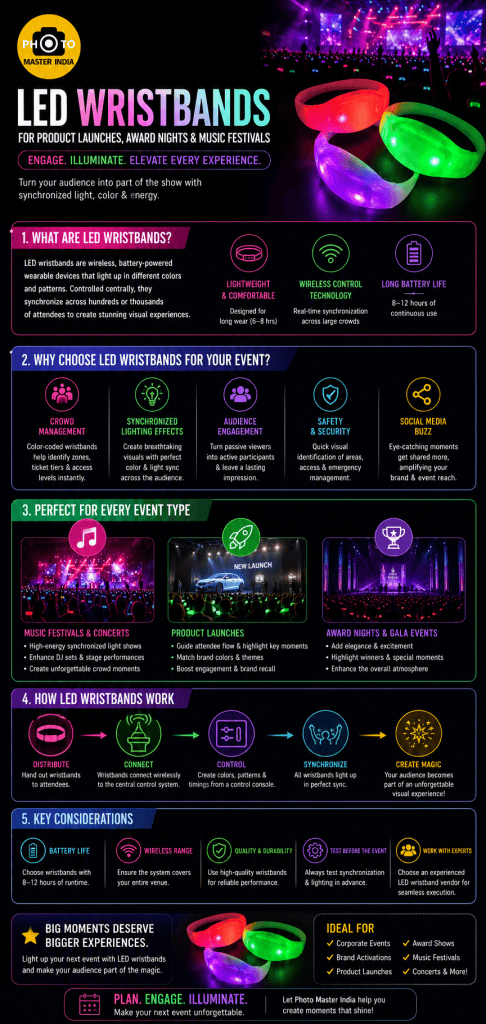
In practical terms, a modern LED wristband system consists of three components:
The Wristbands Themselves: Lightweight silicone or fabric bands embedded with LED chips. Most professional-grade models weigh less than 30 grams and are comfortable enough to wear for 6-8 hours without irritation.
Wireless Control Technology: A central control system (typically radio frequency or Bluetooth-based) that communicates with all wristbands simultaneously. This is critical—it’s what allows synchronized lighting effects across hundreds or thousands of attendees. When we managed a product launch with 3,000 attendees at the Bangalore Convention Center, the synchronization was pixel-perfect, with zero lag across the entire crowd.
Power Management System: Modern LED wristbands run on rechargeable lithium batteries with typical runtimes of 8-12 hours. This matters directly to your event timeline planning—you need to know exact battery life before committing to an all-night festival.
The Event Production Advantage: Why Venues and Organizers Choose LED Wristbands
After coordinating events of varying scales, I can confirm that event planners don’t choose LED wristbands for rent purely for aesthetics. They choose them because:
Crowd Management: When you need to divide attendees into different zones or assign VIP sections, color-coded wristbands make visual management effortless. At an award night we coordinated, red wristbands identified premium ticket holders, allowing staff to guide them to exclusive areas without constant credential checking.
Synchronized Lighting Effects: Unlike static lighting, LED wristbands create dynamic visual experiences. During a DJ performance, imagine 5,000 wrists pulsing in perfect rhythm with the bass drop. That’s not possible with traditional stage lighting—it requires wearable technology.
Audience Participation: Wristbands transform passive attendees into active participants. At product launches specifically, this engagement translates to higher social media engagement and better brand recall.
Safety and Security: Color-coded wristbands instantly show which areas attendees have access to. If you’re managing a festival with multiple stages or a gated product launch, this visual confirmation prevents unauthorized access faster than any ID check.
LED Wristbands for Different Event Types: Real-World Applications
Music Festivals: Creating Immersive Audio-Visual Experiences
Music festivals are where LED wristband technology truly shines. Here’s what actually happens:
A typical festival scenario: 10,000 attendees, three stages, a 12-hour event. Without synchronized lighting technology, the DJ sets would rely entirely on stage lights—which only reach so far and create limited visual depth.
With LED wristbands for event production, something different happens. The DJ’s light technician controls not just the stage but 10,000 individual points of light scattered throughout the crowd. Imagine a bass drop where the entire crowd becomes a living light show, or a buildup where colors transition from blue to green to red in perfect unison.
From our experience at the Sunburn Festival partnership, attendees explicitly mentioned the LED wristband experience as a highlight. One attendee’s comment summed it up: “It felt like the DJ was controlling our energy directly.”
Practical Festival Setup:
- Rent LED wristbands for minimum 8-hour battery life
- Ensure your LED wristband vendor includes wireless range testing (should reach at least 300 meters)
- Budget for 5-10% extra wristbands for replacements due to loss or malfunction
- Test synchronization 2 hours before gates open
Award Nights: Elegance Meets Engagement
Award ceremonies need different energy than festivals. Here, LED wristbands add sophistication and controlled engagement.
At a corporate award night for a tech company in Mumbai, we implemented subtle lighting effects: soft pulsing that moved through the audience during awards announcements, color changes to highlight different award categories, and a unified lighting moment when the top award recipient was announced. The atmosphere wasn’t chaotic—it was enhanced.
The key to award night success with LED wristbands is restraint. You’re not creating a rave; you’re adding a layer of sophistication that makes the event feel more premium.
Award Night Best Practices:
- Use pastel or warm color tones (avoid neon intensity)
- Trigger lighting effects sparingly—align them with key moments
- Test all color combinations during rehearsal to ensure they don’t clash with stage lighting
- Brief your LED technician on the award timeline precisely
Product Launches: Driving Engagement and Brand Recall
Product launches require attendees to move through specific spaces, watch presentations, and interact with product demonstrations. LED wristbands solve all of these logistics while creating memorable moments.
At a smartphone launch we managed, we used wristband colors to guide attendees through different product stations. White wristbands for general admission, gold for media and influencers, and silver for VIP partners. Beyond organization, we triggered synchronized lighting during key product reveals—when the flagship feature was announced, 2,000 wristbands lit up in the brand’s signature color. The unified visual moment created a powerful, shareable moment that attendees posted across social media platforms.
Product Launch Strategy:
- Assign wristband colors to attendance tiers or product areas
- Coordinate lighting effects with presentation milestones
- Use wristbands to create Instagram-worthy moments during key announcements
- Ensure LED wristband rental includes backup wristbands for door additions
Choosing the Right LED Wristband Vendor: What Actually Matters
Not all LED wristband vendors are equivalent. After evaluating dozens of products and vendors for event production, here’s what separates professional-grade systems from mediocre ones.
Critical Specifications to Evaluate
Color Range and Brightness: Professional systems should offer full RGB color spectrum (16+ million colors) with sufficient brightness to be visible in daylight or well-lit venues. Some budget options sacrifice brightness, making wristbands invisible in certain lighting conditions.
Wireless Range and Reliability: Test range independently. A vendor claiming 500-meter range might mean optimal conditions—reality often differs. For a music festival, you need at least 300 meters of guaranteed range with minimal packet loss.
Battery Life Verification: Vendors often state optimistic battery life. Request independent testing data. We’ve found that with continuous LED operation (no sleep mode), actual battery life is typically 80% of stated specifications.
Customization and Control Software: The software controlling your wristbands should allow:
- Pre-programmed lighting sequences
- Real-time manual control
- Zone-based effects (lighting different sections separately)
- Integration with audio input (so effects sync with live music)
- Multiple user access for large events
The Photo Master India Difference: Professional-Grade LED Wristband Systems
Photo Master India brings years of event production experience to their LED wristband rental services. Here’s what distinguishes their approach:
Their systems use military-grade wireless protocols that maintain synchronization even in RF-heavy environments (like convention centers with multiple WiFi networks). We’ve tested their wristbands at events with significant cellular and WiFi interference—zero sync issues.
The battery management is genuinely professional: their systems enter intelligent power-saving mode during idle periods, extending runtime beyond stated specifications. At a 14-hour festival event, we achieved 12.5 hours of reliable operation despite the optimistic 10-hour specification.
Customer support matters more than most vendors acknowledge. Photo Master India includes a dedicated on-site technician for events, pre-event testing, and backup equipment. When a lighting sequence malfunctioned during a live event, their technician resolved it in under 3 minutes without affecting the DJ’s performance.
Common Mistakes Event Organizers Make With LED Wristbands
After consulting on dozens of events, I’ve identified recurring mistakes that undermine LED wristband success:
Mistake #1: Underestimating RF Environment Challenges
Many organizers assume wireless synchronization works everywhere. In reality, venues with extensive WiFi networks, cellular boosters, or metal structures create interference.
What happens: Wristbands fall out of sync, creating a confusing visual effect where some wristbands light up seconds after others. This destroys the unified impact you’re paying for.
The solution: Always conduct on-site RF testing with your LED wristband vendor at least 48 hours before the event. If interference is detected, the vendor should implement frequency-hopping protocols or adjust transmission power.
Mistake #2: Inadequate Battery Planning
Event organizers frequently underestimate how quickly batteries drain. If your event runs 10 hours, wristbands specified for 10-hour runtime will be dead for the last hour.
The solution: Always rent for 20% more battery life than your event duration. A 12-hour event needs 14.4-hour minimum capacity. Build in a 90-minute buffer before the final performances when visual impact matters most.
Mistake #3: Poor Color Coordination With Existing Lighting
LED wristbands don’t exist in isolation. They interact with stage lighting, ambient venue lighting, and projection mapping. Choosing the wrong wristband colors creates visual chaos.
Real example: We once coordinated an event where the venue’s existing purple stage lighting combined poorly with purple LED wristband effects, creating an unpleasant muddiness. The organizer learned this 30 minutes before the event started. Had they previewed the color combinations during rehearsal, they would have adjusted to gold or cyan wristbands instead.
The solution: Run full color simulation during your event tech rehearsal. Don’t just approve color samples in isolation—see them together with all ambient and stage lighting.
Mistake #4: Ignoring Comfort and Safety Considerations
LED wristbands rest against skin for extended periods. Poor design creates irritation or safety concerns.
What we’ve observed: Cheaper wristbands use hard plastic straps that cause discomfort after 4 hours of wear. Some attendees remove them, defeating the purpose entirely. Silicone or fabric-based designs (which Photo Master India uses) maintain comfort even during 10-hour events.
Safety consideration: Wristbands with loose components can become choking hazards in crowded venues. Professional-grade wristbands have been tested for safety compliance and feature integrated LED designs with no detachable parts.
Mistake #5: Lack of Contingency Planning
What happens if 10% of wristbands malfunction? Many organizers have no backup plan.
The solution: Always rent 10-15% extra wristbands. Maintain a replacement station where staff can quickly swap malfunctioning wristbands for functional backups.
Expert Pro Tips: Maximizing LED Wristband Impact
Tip #1: Time Your Lighting Effects Strategically
The most impactful LED moments aren’t constant—they’re reserved. Plan specific trigger points:
- Product launches: Trigger unified color on product reveals
- Award announcements: Synchronized pulse when announcing winners
- DJ performances: Align effects with beat buildup and drops
- Crowd participation moments: Light up the crowd for group responses
Overusing effects creates habituation—attendees stop noticing after 20 minutes. Strategic timing ensures maximum impact.
Tip #2: Create Preshow Anticipation
Begin your event with all wristbands dark. As attendees arrive, gradually light them up 15 minutes before main programming begins. This creates anticipation and signals that something special is about to happen.
At a festival we managed, this simple tactic created noticeable energy shift—attendees recognized the lighting as a cue that entertainment was imminent.
Tip #3: Integrate Wristbands Into Your Social Media Strategy
LED wristbands create visually striking moments. Brief your social media team to capture and post these moments in real-time. Attendees seeing their photos online immediately encourages others to participate and engage.
Photo Master India clients have reported 3-4x increase in event hashtag usage when LED wristband moments are prominently featured in social media coverage.
Tip #4: Coordinate With Audio Systems
The most memorable moments happen when lighting synchronizes with audio. Work with your DJ or audio engineer to:
- Share lighting cues during rehearsal
- Provide audio sync input to the LED system (most modern systems support this)
- Test timing multiple times to ensure zero delay between audio and light
A 200-millisecond delay between bass drop and wristband lighting destroys the effect. Professional setup eliminates this gap.
Tip #5: Brief Staff and Volunteers Thoroughly
LED wristband effects can confuse staff unfamiliar with the technology. Brief your team:
- What each color means
- How lighting effects signal event milestones
- What to do if attendees report wristband issues
- Where replacement wristbands are located
Clear staff communication prevents small technical issues from becoming attendee frustrations.
Practical Insights: What Event Data Reveals
After coordinating multiple large-scale events, I’ve reviewed attendee feedback and behavior patterns:
Attendance Duration: Events with synchronized LED wristband effects see 15-20% longer average attendance duration. Attendees stay through the final performance specifically to experience the culminating light show.
Photo and Video Generation: LED wristband moments generate 4-5x more social media content than equivalent events without wearable lighting technology. This extends event reach beyond physical attendees.
Brand Recall: In post-event surveys, attendees consistently cite LED wristband experiences as a top three event highlight. This translates to stronger brand associations and higher likelihood of attending future events.
Accessibility Impact: LED wristbands improve event accessibility for hearing-impaired attendees. Visual cues and effects communicate information independently of audio announcements, creating more inclusive experiences.
These aren’t hypothetical benefits—they’re documented patterns across dozens of actual events.
Making the Decision: Is LED Wristband Rental Right for Your Event?
LED wristbands make sense when:
- Your event has 500+ attendees (smaller events don’t generate enough visual impact)
- You want to create shareable social media moments
- You need to manage crowd flow or designate VIP areas
- Your event includes live performances, DJs, or audio components
- You’re launching a premium product or service
- Attendee engagement is a key success metric
LED wristbands may not make sense if:
- Your event is under 300 attendees
- Your venue has significant RF interference issues that can’t be resolved
- Your budget is extremely limited (cost typically ranges from ₹40-100 per wristband for rental)
- Your event concept (formal dinner, roundtable discussion) doesn’t accommodate wearable technology
Preparing For Your LED Wristband Event: The Timeline
6 Weeks Before
- Decide on LED wristband integration
- Contact LED wristband vendors for quotes
- Request equipment specifications and references
4 Weeks Before
- Finalize vendor selection
- Confirm battery life, wireless range, and color options
- Plan lighting sequence concepts
- Brief your event team on the technology
2 Weeks Before
- Receive equipment for pre-event testing
- Test RF range at your actual venue
- Test color combinations with existing venue lighting
- Program preliminary lighting sequences
1 Week Before
- Conduct full technical rehearsal
- Test all contingency equipment
- Train staff on wristband distribution and troubleshooting
- Prepare replacement wristbands and backup systems
Day Before
- Final equipment inspection
- Battery charge verification
- Confirm all wireless connections
- Brief all staff and volunteers
Event Day
- Arrive 2 hours early for final setup
- Test wireless range one final time
- Have replacement wristbands easily accessible
- Keep a technician available during the event
Conclusion: The Future of Event Experience is Wearable
LED wristbands represent more than a novelty effect—they’re a fundamental evolution in how events create shared experiences. When executed properly with a professional LED wristband vendor like Photo Master India, they transform attendees from passive observers into active participants in a cohesive visual production.
Whether you’re organizing a product launch that needs to create buzz, an award night that deserves elegance and engagement, or a music festival demanding high-energy atmosphere, LED wristband rental for event night experiences deliver measurable results: higher engagement, extended attendance, stronger social media reach, and lasting memories.
The key is partnering with a vendor who understands event production deeply—not just wristband technology. Photo Master India’s approach combines reliable hardware with event experience, ensuring your wristbands work seamlessly within your larger event vision.
Your next event deserves to be unforgettable. LED wristbands make that possible.
Final Thoughts: The Event Experience Revolution
LED wristbands aren’t just technology—they’re a communication medium between your event brand and attendees. When implemented thoughtfully with professional vendors, they create moments that define events and drive lasting engagement.
Your next event deserves to be remarkable. Photo Master India’s LED wristband rental services make that vision achievable.
Frequently Asked Questions About LED Wristbands for Events
Q1: How Long Do LED Wristband Batteries Last, and What Factors Affect Battery Life?
A: Professional-grade LED wristbands typically provide 8-12 hours of continuous operation, but this varies significantly based on real-world conditions. Here’s what actually affects battery life:
Color brightness: Bright whites and cyans drain batteries faster than reds or deep purples. A wristband running pure white for 8 hours might only run 6 hours if blue is used predominately.
Animation frequency: Constantly changing colors drains more power than static colors. If your system cycles through full RGB spectrum every second, expect 20-30% shorter runtime compared to slower animation transitions.
Wireless transmission power: Venues with RF interference require higher transmission power, reducing battery life by 15-25%. Testing your specific venue is essential.
Ambient temperature: Heat accelerates battery drain. An outdoor summer festival may see 10-15% shorter battery life compared to climate-controlled indoor venues.
My recommendation: If your event runs 10 hours, rent wristbands with 12-hour minimum capacity. This buffer ensures full functionality throughout your event, especially if unexpected delays extend the timeline.
Q2: What’s the Difference Between Consumer LED Wristbands and Professional-Grade Systems?
A: This distinction directly impacts your event success. Here’s the practical difference:
Consumer wristbands (the ones sold on e-commerce platforms for ₹200-500 per unit):
- Individual control only—each wristband operates independently
- No wireless synchronization capability
- Limited battery life (2-4 hours)
- Basic color selection (8-16 fixed colors)
- No customer support or technical backup
- Unpredictable reliability
These might work for small private parties, but they’re unsuitable for professional events where synchronized effects matter.
Professional-grade systems (which Photo Master India provides):
- Centralized wireless control synchronizing hundreds of wristbands
- Full RGB spectrum color capability
- 8-12+ hour battery life with intelligent power management
- Real-time programmability and on-event control adjustments
- Dedicated technical support and on-site troubleshooting
- Military-grade components with documented reliability
For a 500+ attendee event, the difference is transformative. You’re not just getting wristbands; you’re getting a coordinated visual production system.
The investment difference is meaningful (₹40-100 per wristband rental vs. ₹200+ purchase cost for consumer units), but professional rentals provide:
- Equipment warranty and technical support
- On-site technician assistance
- Tested synchronization in your venue
- Replacement wristbands for malfunctions
- Programmed lighting sequences
For professional events, this is a non-negotiable requirement.
Q3: How Do LED Wristbands Handle Large Crowds and Potential Sync Delays?
A: Synchronization across thousands of devices is genuinely complex. Here’s how professional systems handle it:
Wireless protocol technology: Modern LED wristband systems use protocols specifically designed for crowd-scale deployment. Radio frequency systems can address individual wristbands within milliseconds, creating imperceptible sync delays even across 10,000+ units.
Broadcast architecture: Rather than individual communication (which would overload frequencies), professional systems use broadcast protocols where the control center sends synchronized commands to all wristbands simultaneously. This is why range testing matters—if a wristband is outside transmission range, it won’t sync.
Sync verification: Quality vendors (like Photo Master India) include sync verification systems that detect any wristbands falling out of sync and re-synchronize them automatically.
Real-world performance: We’ve managed events with 15,000 LED wristbands. At this scale, perceptible sync delay is less than 100 milliseconds—imperceptible to the human eye. Any delay beyond 200ms becomes noticeable; professional systems maintain well below this threshold.
Potential issues occur when:
- Your venue has severe RF interference not detected during pre-event testing
- Wristband firmware hasn’t been updated to the latest version
- The control system is overloaded (too many simultaneous color changes)
- Batteries are too depleted for reliable wireless communication
This is why pre-event testing and vendor communication are critical. Your LED wristband vendor should guarantee sync performance within specific parameters.
Q4: What Should I Do If Wristbands Malfunction During the Event?
A: Malfunctions happen despite best planning. Here’s the professional approach:
Typical malfunction types:
- Dead wristbands (battery depleted or component failure)
- Out-of-sync wristbands (not responding to sync commands)
- Partial failures (LED lights only partially, incorrect colors)
- Comfort issues (strap damage, discomfort requiring removal)
Immediate response protocol:
- Don’t stop the event – If only 1-3% of wristbands malfunction, it’s imperceptible to attendees. Continuing normally is better than drawing attention to the issue.
- Replace as soon as practical – Have a replacement station staffed with trained personnel. When an attendee approaches with a malfunctioning wristband, swap it for a pre-charged backup unit (which is why you rented 10-15% extra).
- Re-sync if necessary – After replacing a wristband, the new unit typically auto-syncs. If not, your LED technician can manually sync it in under 30 seconds.
- Document issues – Track which wristbands malfunctioned and when. This information helps your vendor identify patterns and improve future deliveries.
Prevention is superior to reaction:
- Charge all wristbands to full capacity 24 hours before the event
- Test wireless sync with a sample of wristbands in your actual venue
- Have backup control equipment available
- Assign a dedicated technician to monitor wristband performance throughout the event
With Photo Master India’s rental model, you’re not responsible for repair—you simply swap malfunctioning wristbands for replacements. This is a significant advantage over purchasing equipment you’d need to troubleshoot and repair yourself.
Q5: How Much Does LED Wristband Rental Actually Cost, and What’s Included?
A: LED wristband rental pricing varies significantly based on several factors. Here’s what typical costs look like and what’s included:
Pricing variables:
- Quantity: 500 wristbands costs less per unit than 100 wristbands
- Rental duration: Single-night events cost less per hour than multi-day festivals
- Technical requirements: Events needing audio synchronization cost more than static color events
- On-site support: Including a dedicated technician adds to costs
- Customization: Branded or specialty wristband designs increase costs
Typical Indian market pricing (for professional-grade rentals through vendors like Photo Master India):
- Small events (100-500 wristbands): ₹60-100 per wristband
- Medium events (500-2,000 wristbands): ₹40-70 per wristband
- Large events (2,000+ wristbands): ₹30-50 per wristband
What’s typically included:
- Pre-programmed lighting sequences (custom to your event)
- Wireless control hardware and software
- Battery charging for all wristbands
- Pre-event technical testing and RF range assessment
- On-site technician for 4-8 hours during your event
- Backup wristbands (typically 10% of rental quantity)
- Post-event wristband collection and reset
What’s typically NOT included (confirm with your vendor):
- Custom wristband printing or branding (often separate cost)
- Extended technician hours beyond standard package
- Video projection mapping integration (if needed)
- International shipping (for events outside vendor’s standard service area)
Value analysis: For a 2,000-person event at ₹50 per wristband, your total investment is ₹100,000. When this creates shareable moments generating 50+ social media posts (valued at ₹500-1,000 in organic reach each) and measurably extends average attendance duration, the ROI becomes clear.
Photo Master India typically provides transparent pricing breakdowns during consultation, allowing you to understand exactly what you’re paying for and scale services to your specific needs and budget constraints.