
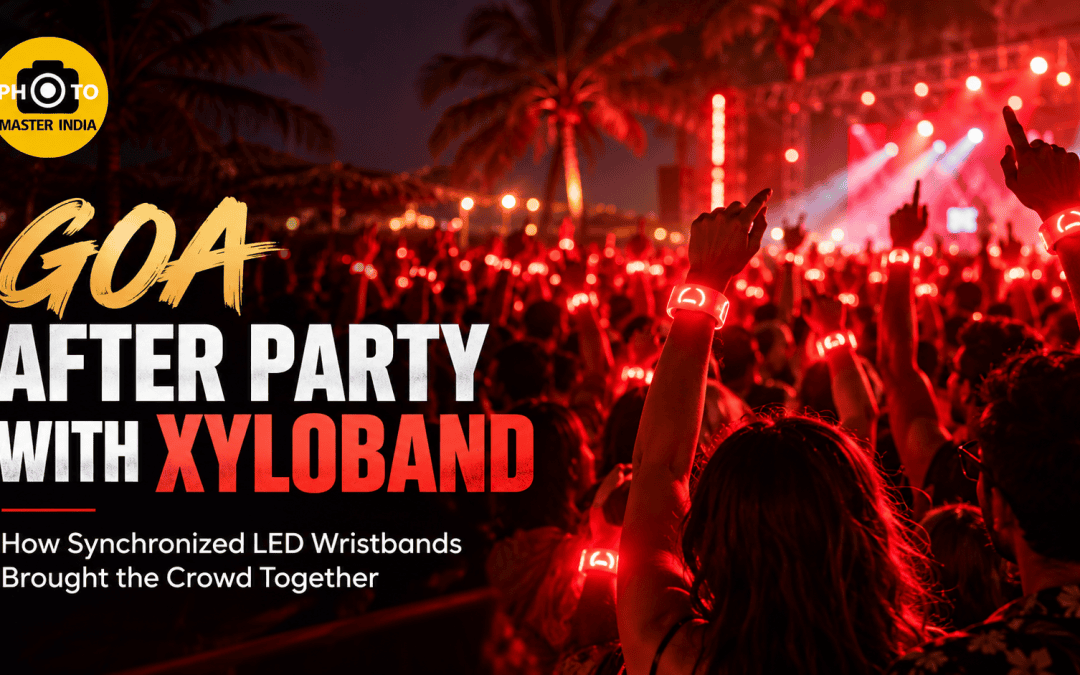
Most after-parties follow the same script. The main event ends, the music shifts, and the crowd thins out as people drift toward their rooms, their cars, or the next beach. Lights are dim, phones come out, and the energy depends almost entirely on the DJ. That is the gap we set out to close when we planned the GOA After Party with Xyloband on 20 May 2026.
A wristband that lights up in sync with the music turns every guest into a moving part of the show, and it is one of the simplest ways to bring a crowd together without a stage build. This case study walks through why the client chose to rent Xyloband, how we planned and ran the setup, and what we would repeat at the next event.
About the Event
The GOA After Party took place in Goa on 20 May 2026, and it was built around a single idea: keep the energy of the night going after the main programme ends. The format was a late-evening, music-led gathering, the kind of event where guests arrive in mixed groups, move between the dance floor and the bar, and expect the night to feel personal rather than scripted.
Goa has a long-standing party culture, and its after-parties tend to be smaller, looser, and more social than daytime festivals. Guests arrive in mixed groups, travel between venues, and expect the night to feel personal rather than scripted.
For the organisers, the after-party was about more than music. It was a chance to keep the energy of the day going, give guests a reason to stay on the floor, and create something people would talk about once they were back home. That goal shaped every choice that followed.
Client Requirement
The client came to us with three practical goals:
- Get a large share of the crowd moving together, not just the front row.
- Keep the setup light enough to fit a venue that was not built for production gear.
- Make sure the lights worked with the music, not against it.
They chose Xyloband because it is a proven format for synchronised crowd lighting. Each guest wears an LED wristband, and the lights can be controlled remotely to pulse, change colour, or flash in time with the set. The Wikipedia entry on Xyloband describes a remote range of up to 300 meters, which gives operators plenty of room inside a single venue (Wikipedia).
Success, as the client framed it, meant a crowd that stayed on the dance floor for the whole set, guests who wore their wristbands for the entire night, and a visible, shareable moment that matched the event’s look.
Challenges
Lighting a party with wristbands is easy to describe and harder to execute. These were the issues we planned for:
- Crowd engagement. Wristbands only work if people wear them. A crowd that hangs back at the bar will not light up the room.
- Footfall and movement. After-parties rarely have a single entry point. Guests arrive in waves, so distribution had to keep pace without creating a queue.
- Space limits. Venues in Goa vary from open beach decks to compact indoor rooms. Equipment had to fit without crowding the dance floor.
- Time pressure. The window for setup was short, and the venue was busy with its own preparations.
- Logistics and power. Lighting controllers and receivers need a stable power supply, and the layout had to keep cables out of the walking path.
- Brand visibility. The client wanted the event identity to show up in the light show without overpowering the music.
Our Solution
Product selection
We proposed Xyloband wristbands with a remote controller, because the brief leaned toward one shared visual moment rather than individual effects. Wristbands keep the setup simple: guests put them on at the entrance, and the crowd becomes the lighting rig.
The wristbands are also available through our Xyloband product page, and we use the same range for LED wristband bookings at other events.
Strategy and planning
Our planning focused on three questions:
- How many wristbands for the expected crowd? We planned for a buffer above the guest count so that late arrivals and guests who lost a band still joined in.
- Where do people gather? We placed the controller and the main activity near the dance floor, not in a corner where guests would walk past without noticing.
- How does the lighting follow the set? We agreed with the organisers on a simple sequence: slower pulses during the warm-up, stronger colour changes for peak moments, and a clear finish.
Team coordination
Coordination with the organiser’s team mattered as much as the hardware. We agreed on load-in timing, the entry point for distribution, and who would handle the band hand-out. The DJ and the lighting operator needed a short cue sheet so that the lights landed on the drops rather than drifting out of step.
Setup and technology
On the day, our team handled the controller, the receivers, and the power distribution. We kept all cables taped down along the edges of the floor and ran a full test before doors opened, checking that every band responded to the controller from the back of the room. Testing from the far end of the venue is the step most often skipped, and it is the one that catches dead spots.
User journey
From a guest’s point of view, the journey was simple:
- At the entrance, a team member fitted a wristband and gave a one-line brief: keep it on for the night, and watch what happens when the music changes.
- On the floor, the wristbands responded to the set. The effect built as the crowd filled in.
- Guests who had not planned to dance found themselves part of a lit-up crowd, which pulled more people in.
Event Execution
The setup began in the afternoon with a walk of the venue, a check of the power points, and a placement plan agreed with the organisers. Equipment came in through a single route to avoid blocking the entrance. Once the controller was live, we ran the wristbands through each colour and pattern to confirm that the crowd would see what the DJ and the organisers had planned.
During the event, our operator stayed at the controller and worked from the cue sheet. The first hour was about building the room: guests were still arriving, and the lights were kept gentle so they would not distract from conversation. As the set moved into its peak, the operator stepped up the patterns and matched them to the music.
The team on the floor handled the practical things: topping up the band hand-out for latecomers, checking that wristbands were still working, and helping guests who were unsure how to wear them. We kept an eye on the power supply and on the cable runs, which is where most problems show up at a party.
Audience response was visible from the first big change in the music. Guests turned toward the lights, started filming, and moved closer to the dance floor. The crowd stayed in the room longer than the organisers had expected for the late slot.
Results and Outcomes
This section describes what the activation was designed to deliver and what we recommend measuring at future events. The brief did not include audited figures, so no counts or percentages are stated here.
- Crowd on the floor: the setup was built to keep people dancing through the set, not just the front row.
- Shared moment: the synchronised lighting gave the room one visual focus that tied the crowd to the music.
- Wristbands kept on: guests who wear the band for the whole night extend the effect across the event.
- Measure next time: count wristbands distributed, note how long the crowd stays on the floor, and track social posts that use the event hashtag.
Taken together, the event showed that a light show built on wearable bands can bring a late-night crowd into one shared moment, even with a compact setup and a short setup window.
Key Takeaways
- Test from the far end of the room. A band that works at the controller may not work at the back of a crowded venue.
- Plan the cue sheet with the DJ. Lights that land on the drops feel intentional. Lights that drift feel like a mistake.
- Keep cables out of the walk path. Most after-party problems come from cables and power, not from the lighting itself.
- Start gently. A slow build gives latecomers time to join without the room feeling empty at the start.
- Over-order slightly. Plan a buffer of wristbands for lost or late guests.
Why This Matters for Future Events
Brands, wedding planners, and event organisers who run late-night events can take three lessons from this case. First, the crowd is part of the production. Wristbands make that visible, and the lighting becomes a shared experience rather than a backdrop.
Second, the planning that matters most happens before the event: the cue sheet, the placement, and the test run. Third, a light show does not need a big budget or a large footprint. It needs a clear plan and an operator who watches the room.
For organisers looking to rent Xyloband for a similar event, start with three questions: how many guests you expect, how the crowd will move through the venue, and who will run the controller on the night. Those answers shape almost every other decision.
Expert Insights
Experience from setups like this one points to a few practical habits:
- Give guests a reason to keep the band on. A short brief at the entrance does more than a long explanation later.
- Watch the room, not the controller. The best patterns are chosen by looking at how the crowd is moving, not just by the cue sheet.
- Check the power twice. Lighting that flickers in the middle of a set is the fastest way to lose a crowd.
- Decide the finish early. Know how the night will end before you start, so the last song is as strong as the first.
Conclusion
The GOA After Party with Xyloband showed how a simple wearable can turn a late-night crowd into one connected room. The lights did not replace the music or the organisers’ work. They gave guests a reason to stay on the floor and a moment worth remembering.
If you are planning an after-party, a festival night, or a private celebration in Goa and want to explore a Xyloband vendor in Goa setup, reach out to Photo Master India to talk through your crowd size, venue, and timing.
Frequently Asked Questions
What is a Xyloband, and how does it work at a party?
A Xyloband is an LED wristband that lights up in response to a remote controller. At a party, the operator sends light patterns to the whole crowd, so the wristbands pulse, change colour, or flash in time with the music. The Wikipedia entry on Xyloband describes a remote range of up to 300 meters, which is more than enough for a single venue (Wikipedia). The effect works best when the operator follows the music closely and plans patterns around the set.
How many Xyloband wristbands do I need for my event?
Start with your expected guest count and add a buffer for late arrivals and lost bands. In our experience, planning for a little more than the headcount avoids gaps in the crowd. The right number also depends on how many guests you want to light up at once, which is why it helps to share your venue size and the layout of the dance floor with your vendor before quoting.
What should I check before I rent Xyloband for an outdoor or beach venue?
Ask about power supply, weather cover for the controller, and how the cables will be run. Beach and open-air venues need protection from sand, humidity, and sudden rain. Also test the full range from the far end of the venue, since open spaces can behave differently from enclosed rooms. A short test before guests arrive is worth the time.
How do I keep guests engaged with the wristbands for the whole night?
Give a short, clear brief when wristbands are handed out, and keep the early patterns gentle so the crowd does not feel overwhelmed. Build the effect as the night goes on, and save the strongest patterns for the peak of the set. Watching how the crowd responds and adjusting in real time makes a bigger difference than any preset sequence.
What makes a Xyloband setup different from a standard party light show?
A standard light show lights the room. A Xyloband setup lights the people in it. Because every guest wears a band, the crowd becomes part of the visual, which is especially effective for a party where people are mixing and moving. The setup is also compact compared with stage lighting, so it suits venues where space and power are limited.